Nagasaki Cruise Port: DIY Tram or a Private Tour?
Practical planning for a Nagasaki port day
Facts checked 8 October 2026. Transport, access and booking conditions can change.
For a Nagasaki cruise stop at Matsugae, this guide covers the tram route to Peace Park, payment choices and return planning. A compact DIY visit can suit travellers who are comfortable walking and changing trams. A private vehicle with a confirmed English-speaking guide is worth comparing when you want interpretation or fewer transport decisions. Confirm your berth and all-aboard time first; directions from Matsugae do not apply to every Nagasaki berth.
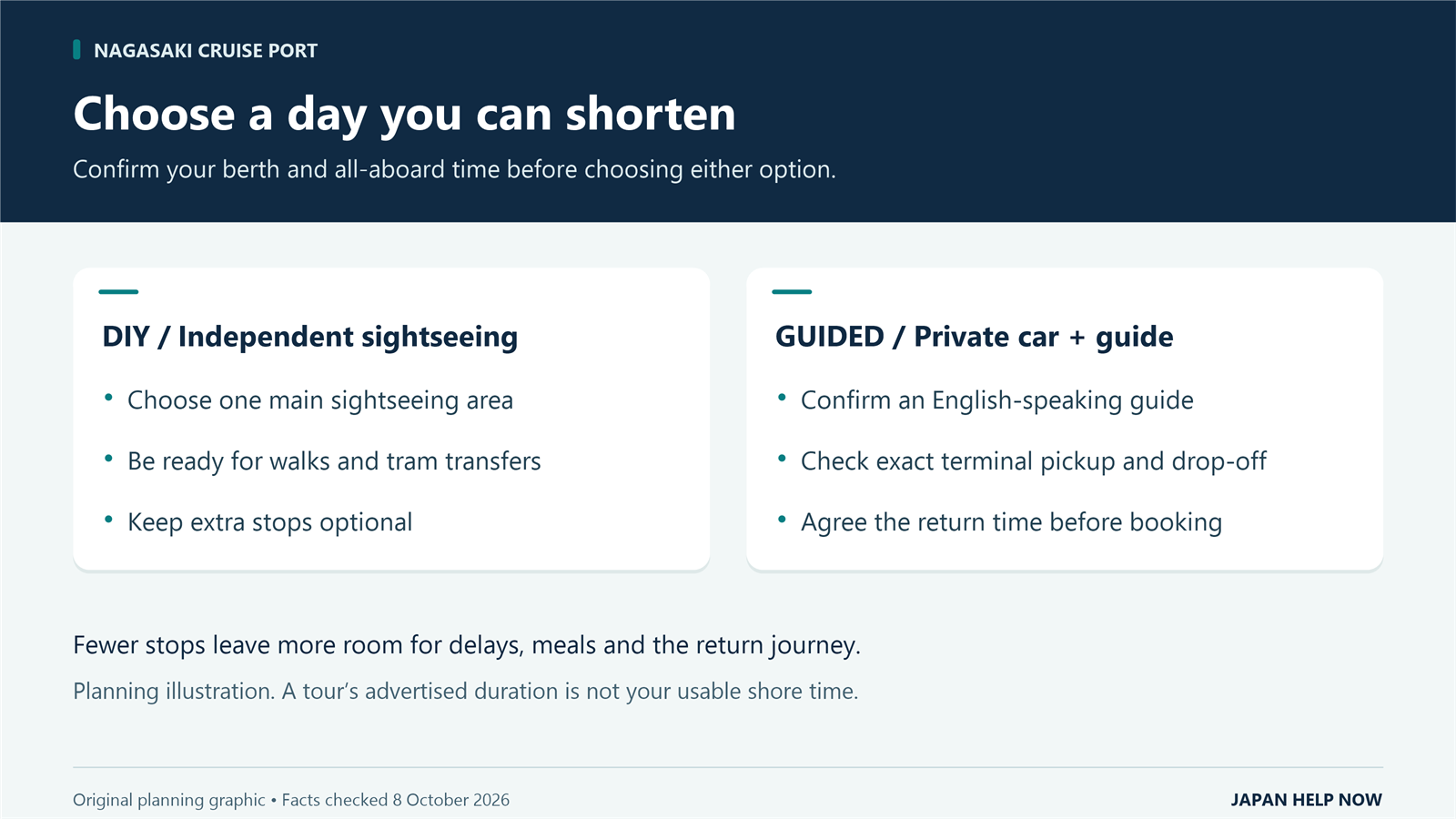
Choose a compact DIY outing or confirm the guide, terminal pickup and return time for a private tour. Original JHN planning illustration.
Open the full-size illustration
Text version: Choose a day you can shorten
Confirm your berth and all-aboard time before choosing either option.
DIY / Independent sightseeing
- Choose one main sightseeing area
- Be ready for walks and tram transfers
- Keep extra stops optional
GUIDED / Private car + guide
- Confirm an English-speaking guide
- Check exact terminal pickup and drop-off
- Agree the return time before booking
Fewer stops leave more room for delays, meals and the return journey.
Planning illustration. A tour’s advertised duration is not your usable shore time.
Original planning graphic · Facts checked 8 October 2026 · Japan Help Now
Confirm the berth before choosing the route
Nagasaki’s official cruise schedule identifies the berth as well as arrival and departure times. It includes both Matsugae and Dejima calls and warns that plans can change. Check your ship and date, then confirm the terminal with your cruise line. The directions below start at Matsugae; they are not directions from every place called Nagasaki Port. Official Nagasaki cruise schedule · 2026 Nagasaki berth schedule
If your itinerary says Sasebo, stop and plan from that port instead. Do not assume that a tour described as Nagasaki pickup will collect you there. Save your terminal name, your ship’s local emergency contact and a map offline. Confirm whether ship time matches the time shown on your phone.
An important museum update for autumn and winter
The Nagasaki Atomic Bomb Museum is carrying out a phased exhibition renewal. Its notice, checked on 8 October 2026, schedules part of Area A to be screened off from 10 September through 10 October 2026. Further partial closures are planned between late November 2026 and March 2027. Areas outside the works remain open, including most of Area B. Check the latest notice before making the museum the main reason for your trip. Museum partial closure notice
Choose one main sightseeing area
A shorter list gives you room for queues, a meal and an unhurried return. These are route choices, not promises that every stop will fit your sailing.
Considering Gunkanjima (Battleship Island) during your port day? Read our Gunkanjima from a Nagasaki cruise ship guide for check-in locations, return planning and the conditions to check if landing is not possible.
Stay near the southern waterfront
From Matsugae, the Glover Garden and Oura area is a practical starting point for a compact outing. Choose one paid attraction and leave room for the streets and waterfront instead of treating every nearby landmark as a required stop. The port’s older attractions overview places Glover Garden and Oura Church near Matsugae. Use it for orientation, and check the present walking route from your actual terminal exit. Port attractions overview
Glover Garden’s standard adult admission is ¥1,300 following its April 2026 revision. Normal hours are 8:00–18:00, with seasonal evening extensions and last admission 20 minutes before closing. The garden has slopes and cobblestones; its moving walkways do not make the whole site step-free. If you need assistance, check the accessible route in advance. Gate 2 does not accept card payments. Glover Garden visitor information
Make Peace Park and the museum the focus
Take the tram north if this is your priority, and treat any southern sightseeing afterward as optional. The Atomic Bomb Museum’s regular adult exhibition admission is ¥200. Its visitor guide lists 8:30–17:30 in April and September–March, with last entry at 17:00; May–August has later closing. It closes from 29 through 31 December. Review the partial-closure notice above as well as the opening hours. Atomic Bomb Museum admission information · Atomic Bomb Museum visitor guide
Leave time to absorb the material rather than squeezing the museum between several distant stops. If the outward journey takes longer than expected, shorten the rest of the day before reducing your return margin.
Matsugae to Peace Park by tram
The prefecture’s visitor guide gives this route from Matsugae International Terminal: Official port to Peace Park directions
- Walk to Ourakaigan-dori, stop 48. Confirm the walking route from the terminal exit.
- Take tram 5 toward Hotarujaya.
- At Shinchi Chinatown, stop 31, change to the other platform using the designated crossing.
- Take tram 1 toward Akasako and leave at Peace Park, stop 19.
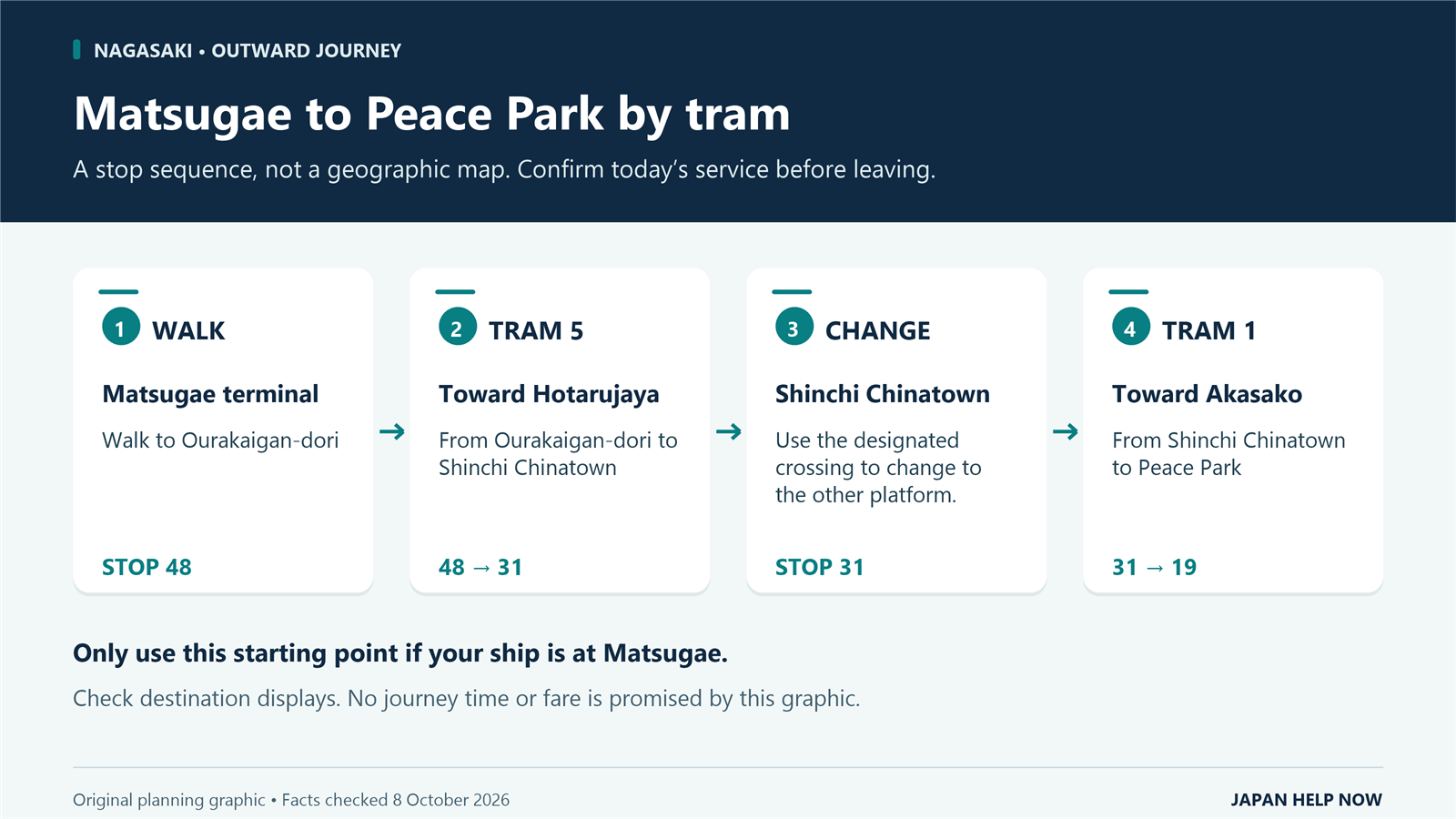
Outward tram sequence from Matsugae only. This original diagram is not a geographic map; confirm the current service and destination displays.
Open the full-size illustration
Text version: Matsugae to Peace Park by tram
A stop sequence, not a geographic map. Confirm today’s service before leaving.
WALK
- Matsugae terminal
- Walk to Ourakaigan-dori
- STOP 48
TRAM 5
- Toward Hotarujaya
- From Ourakaigan-dori to Shinchi Chinatown
- 48 → 31
CHANGE
- Shinchi Chinatown
- Use the designated crossing to change to the other platform.
- STOP 31
TRAM 1
- Toward Akasako
- From Shinchi Chinatown to Peace Park
- 31 → 19
Only use this starting point if your ship is at Matsugae.
Check destination displays. No journey time or fare is promised by this graphic.
Original planning graphic · Facts checked 8 October 2026 · Japan Help Now
For the reverse journey, the operator’s route map shows tram 1 toward Sofukuji Temple, changing at Shinchi Chinatown to tram 5 toward Ishibashi for Ourakaigan-dori. Check the destination display rather than relying on a tram’s colour. This is a route description; it does not include a guaranteed journey time. Tram operator route and payment guide
Board at the middle or rear door unless directed otherwise and leave at the front. With a cashless payment method, tap when boarding and again when leaving. Cash passengers pay on exit; the fare box does not give change. The operator says its change machines accept coins and ¥1,000 notes. How to ride the tram
Nagasaki tram fares: cash, IC cards and day passes
The ordinary adult fare is ¥150. A one-day tram pass is ¥600 and covers the operator’s tram network for that day, not city buses. Tram operator passenger and fare rules
For the two-tram journey above, paying the ordinary adult fare in cash means ¥300 each way, or ¥600 return. Cash does not qualify for the ordinary cashless transfer discount. With an eligible transport IC card or contactless payment, a qualifying transfer at Shinchi Chinatown can avoid a second full fare. Use the same payment method throughout and give each passenger their own card; board the second tram within 30 minutes of leaving the first. Tram operator route and payment guide
There is a useful detail on the short first leg: the operator’s rules allow a short-distance fare initially, then collect the difference on the second leg when the complete journey exceeds two sections. For the full route to Peace Park, budget ¥150 each way when all ordinary adult cashless transfer conditions are met, not ¥110 for the whole journey. Tram operator passenger and fare rules
A day pass is convenient, but it is not automatically cheaper. Four ordinary ¥150 cash fares total ¥600, so the pass only matches that simple return itinerary. Eligible cashless transfers can make pay-as-you-go cheaper. Extra stops, short-distance discounts and current contactless offers change the comparison. Work out the journeys you will actually make before buying.
Add Dejima only if the remaining time works
Dejima is another possible focus or optional stop. Its adult admission is ¥1,100 from 1 April 2026. The official site lists visiting hours of 8:00–21:00, with last entry at 20:40, but the Water Gate closes earlier at 18:00. Use the opening information for the entrance you plan to use. Dejima April 2026 admission revision · Dejima opening and visitor information
Late attraction hours do not extend your time ashore. If your return deadline is approaching, skip the extra admission and return to the berth. A port day does not need to include Glover Garden, Dejima and the museum to be worthwhile.
When a private car and English guide make sense
A vehicle can reduce transfers, while a guide can explain what you are seeing. Confirm both: an English booking page alone does not establish that a driver gives spoken-English guiding. Choose fewer stops if anyone needs a slower pace, and verify vehicle access separately from access inside each attraction.
One comparison candidate is the Nagasaki private car tour with a licensed guide sold on Viator, product 92136P277. The retrieved listing describes roughly six hours, an English-speaking licensed guide, a private vehicle and a choice of three or four sights. Its pickup information covers Nagasaki City and specifically excludes Sasebo Port. Several listed attraction visits have admission fees excluded. This is a listing-based comparison, not a personally tested recommendation. Nagasaki private car and licensed guide listing
The listing showed cancellation up to 24 hours before the experience for a full refund. Before booking, check the selected option’s local-time deadline, date-specific total and the written policy if your ship arrives late or skips Nagasaki. A six-hour tour does not automatically fit a six-hour port call. Disembarkation, meeting and reboarding use part of that window.
Ask the provider to confirm the exact terminal pickup and drop-off, guide language, walking demands, vehicle capacity, admissions, lunch costs and an agreed return time. If those answers do not fit your sailing, choose a shorter tour or the compact DIY option.
Compare your cruise line excursion terms too
A ship-booked excursion may have different disruption protection. For example, Princess describes a return-to-ship commitment for its own excursions, with onward transport to the next port when the ship must leave. That is a specific cruise-line policy, not a protection to assume for an independent tour or another cruise line. Read the terms for your sailing. Princess shore excursion return policy
Work backward from all aboard
The following buffers are JHN planning advice, not an official port rule, transport timetable or guarantee. Follow any earlier return instruction from your ship.
- Write down all aboard, not just the scheduled sailing time.
- For an independent outing, a practical starting point is to aim to reach the correct terminal at least 60 minutes before all aboard. You still need time to enter and reboard.
- From that terminal target, subtract the current journey estimate from your final sightseeing stop, including walks, waits and transfers.
- Add a separate contingency allowance. Start with at least 30 minutes for a simple tram return and increase it for crowds, poor weather, access needs or uncertain service.
- Set an alarm for your latest departure from the final stop. Drop optional sightseeing if you fall behind.
Example only: if all aboard is 15:30, a 60-minute terminal margin gives a 14:30 target. If your checked return estimate is 45 minutes and you add 30 minutes of contingency, leave the final stop by 13:15. The 45 minutes is an arithmetic example, not a verified Peace Park-to-port travel time.
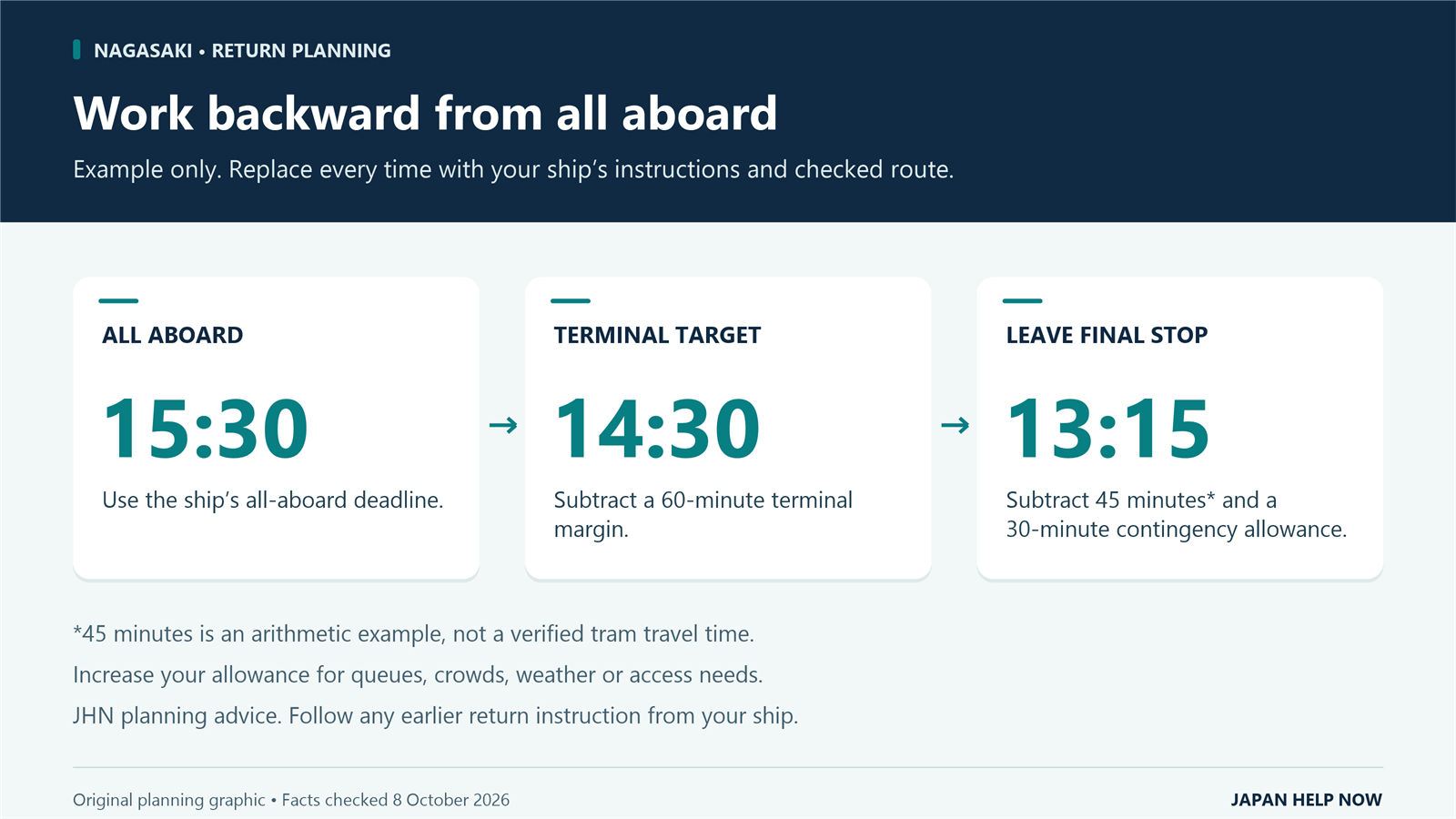
Arithmetic example only: 15:30 − 60 minutes − 45 minutes − 30 minutes = 13:15. These are JHN planning assumptions, not a transport timetable or official port rule. Follow any earlier ship instruction.
Open the full-size illustration
Text version: Work backward from all aboard
Example only. Replace every time with your ship’s instructions and checked route.
ALL ABOARD — 15:30
- Use the ship’s all-aboard deadline.
TERMINAL TARGET — 14:30
- Subtract a 60-minute terminal margin.
LEAVE FINAL STOP — 13:15
- Subtract 45 minutes* and a 30-minute contingency allowance.
*45 minutes is an arithmetic example, not a verified tram travel time.
Increase your allowance for queues, crowds, weather or access needs.
JHN planning advice. Follow any earlier return instruction from your ship.
Original planning graphic · Facts checked 8 October 2026 · Japan Help Now
If you cannot establish a reliable return route, stay closer to the berth. Keep enough money for an alternative, but do not assume a taxi will be immediately available or faster in traffic. Ask terminal staff about current conditions before setting off, and keep the ship’s contact details accessible without mobile data.
What to check before leaving the ship
- Correct berth, all-aboard time and which clock to follow
- Today’s tram service and your payment method
- Museum closure notice and the attractions you actually want to enter
- Walking comfort, weather, charged phone and an offline route
- Latest turn-back time and a shorter plan if anything changes
Choose DIY when you are happy with a small number of sights and managing the journey yourself. Choose a private tour when its guiding, pickup and timing solve a real need. In either case, protect the return window first.
Planning another Kyushu port day
For another stop on your itinerary, read our Kagoshima cruise-port comparison, including the difference between Marine Port and Kita-futo. Kagoshima cruise port DIY or shore excursion
If you want to visit the volcano independently, our Sakurajima guide explains the ferry, walking and local transport choices. Sakurajima without a car